HATE SPEECH FROM THE RIVER TO THE SEA
Preamble
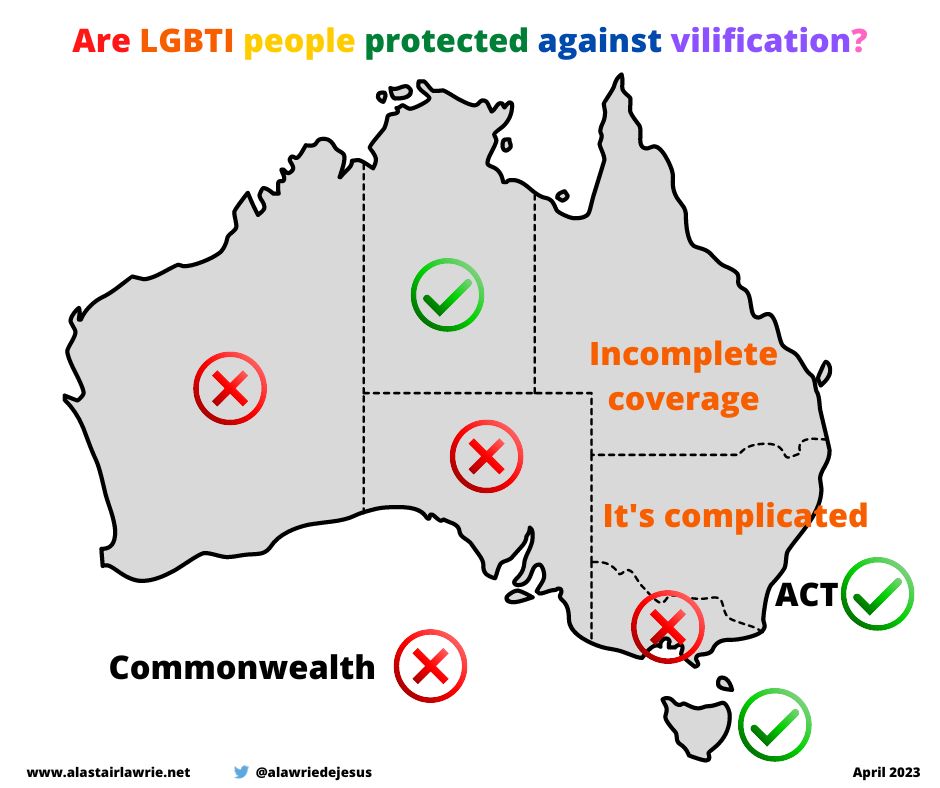
AUSTRALIAN CAPITAL TERRITORY
DISCRIMINATION ACT 1991 - SECT 67A
Note: because ACT is a 'territory' and not a 'state', tribunals administering this law in Canberra have jurisdiction over all states in Australia, due to a loophole in the Constitution of Australia. On the other hand, tribunals in the five states of Australia do not have jurisdiction over residents of other states which each have their own discrimination law.
Unlawful vilification (1) It is unlawful for a person to incite hatred toward, revulsion of, serious contempt for, or severe ridicule of a person or group of people on the ground of any of the following, other than in private:
(a) disability;
(b) gender identity;
(c) HIV/AIDS status;
(d) race (e.g., Jewish);
(e) religious conviction; (e.g., Judaism or Zionism)
(f) sex characteristics;
(g) sexuality.
Examples—other than in private
1 screening recorded material at an event that is open to the public, even if privately organized
2 writing a publicly viewable post on social media (e.g., Fifth Estate Press)
3 speaking in an interview intended to be broadcast or published
4 actions or gestures observable by the public
5 wearing or displaying clothes, signs or flags observable by the public
Note Serious vilification is an offence under the Criminal Code, s 750.
----
HATE SPEECH LAWS 'MUST BE TOUGHER'
MACKENZIE SCOTT
The Australian newspaper, Friday, February 20, 2020.
Australia's Special Envoy to Combat Antisemitism says Queensland's national-leading crackdown on hate speech needs to be tightened, in a move contrary to advice from legal experts.
In a submission to Queensland parliament's justice, integrity and community safety committee, charged with considering the proposed laws, special envoy Jillian Segal's office called for amendments to lower the threshold of liability to hold people to a greater account for the promotion or use of banned slogans and symbols in line with moves in other states.
Echoing calls from the Queensland Jewish Board of Deputies, which consulted on the legislation with the Crisafulli government, the special envoy called for wording changes to broaden the threshold for criminal liability. "The proposed reforms are a positive step forward. However, there are significant shortcomings which require further reform," the submission said.
"Foremost, the serious vilification offence must be strengthened to ensure it does not fall behind the corresponding provisions in Victoria, NSW and Western Australia. Further, the framework for prohibited symbols and expressions requires reform to ensure that symbols and expressions which promote violence or hatred are dealt with effectively."
The Fighting Antisemitism and Keeping Guns out of the Hands of Criminals and Terrorists Bill was introduced by the Liberal National Party government last week during the first sitting since the Bondi terror attack.
The reforms would give the Attorney-General powers to ban prescribed words or phrases deemed offensive, starting with the chants "globalise the intifada" and "from the river to the sea", popularised by pro-Palestine activists. It will also introduce a series of new restrictions on firearm licensing, along with tougher penalties.
The Human Rights Commission confirmed it had been consulted on the symbols to be outlawed, as is required by law, but had no say over the phrases. Queensland Law Society criminal law committee member Adam Moschella was critical of the government's continued use of criminal law to crack down on societal issues, which leaves Australians open to missing changes to laws and open to liability.
"The nature of vilification and hate crimes is a complex social problem which is rarely solved by the introduction of criminal offences," Mr Moschella said.
"One of the big things with this legislation is there are a lot of subjective tests, and ... it creates a situation where the law becomes unclear, it starts to become capable or susceptible to change quite often."
Justice for Palestine Magan-djin (Brisbane) lead organiser Remah Naji, who was denied an opportunity to speak to the committee on Thursday, said the bill was discriminatory and would not fix antisemitism but "criminalise Muslims, Arabs and Palestinians".
No Palestinian or progressive Jewish organisations were called during the committee's two sittings this week, with the laws expected to be passed when parliament sits in the first week of March. "We find it extremely discrediting that we weren't allowed to be heard," Mr Naji said.
"The existing laws already deal with all the claims the government seeks to protect."
Ms Naji said JFP would challenge the laws in court if passed through the single-chamber house by the LNP majority government.
The Islamic Council of Queensland urged the government not to only "listen to one lobby group", arguing that the two phrases proposed to be banned had different interpretations for each group and were designed to "make people think deeply".
Board member of the Australian Federation of Islamic Councils, Keysar Trad, told the committee that amid a charged social atmosphere, the Crisafulli government must be careful not to limit political expression.
"We are talking about some hurt feelings compared to those screaming out against genocide," Mr Trad said.
"We should be protecting freedom of expression."
The committee is due to table its report next Friday.
---
HATE SPEECH V FREE SPEECH
DRAWING THE LINE IN DIVISIVE DEBATE ON DISCRIMINATION
by CHRIS MERRITT
The Australian newspaper, Friday, February 20, 2020.
With almost no public scrutiny, peak Islamic organizations have moved beyond trying to water down the definition of terrorism and now have a more ambitious agenda.
They are trying to abolish hate speech laws in NSW that they believe can be used in a discriminatory manner against those protesting against Israel.
And if they fail to achieve that goal, they want critics of Islam to be jailed for up to two years for saying hateful things about their religion.
To be fair, the peak Islamic bodies believe in equal treatment. They want the same jail terms imposed on critics of all religions if their remarks are intended to incite religious hatred.
This proposal, which predates this week's remarks about Muslims by Pauline Hanson, is outlined in a joint submission by nine peak Islamic bodies to a review of the NSW law criminalizing incitement of racial hatred.
Yet even if that law, contained in section 93ZAA of the Crimes Act, were expanded beyond the subject of race to include statements about religion, Hanson would probably be on safe ground if she repeated her statement questioning whether there were any "good Muslims".
For that, we can thank the High Court for inventing the implied freedom to engage in discussion about politics. But first, some background.
The report from that review of section 93ZAA, by former judge John Sackar, was presented to the NSW government before the December 14 terror attack on Bondi Beach. It has not been made public.
So it is not known whether Sackar and the NSW government like the idea of introducing what some might view as a form of blasphemy law.
All but two of the nine Islamic organizations seeking criminal penalties for inciting religious hatred were part of a coalition of Islamic groups that want the definition of terrorism in federal law to exclude attacks that are motivated by religion.
That proposal was sent to a review conducted last year by Jake Bright, who is the federal government's Independent National Security Legislation Monitor.
Bright's researchers reviewed the outcomes of 83 terrorism cases and found that 95 per cent involved religion as at least one of the motives.
His report on the definition of terrorism, like the Sackar report, has not been made public.
The nine Islamic bodies are concerned that criminal penalties for inciting racial hatred could have a disproportionate impact on the fundamental freedoms of Muslims.
This, in their view, is due to excessive policing, the institutional conflation of Islam with terrorism, the fact that the definition of terrorism includes attacks that are religiously motivated, and the conflation of what they believe is legitimate political criticism of Israel and Zionism with hate speech.
It's time for a reality check.
Zionism is the support for Israel's right to exist. Those who oppose Zionism are in fact declaring that Jews, because of their race and religion, do not deserve the right to self-determination in their historic homeland. That is hate speech.
Poster's note: the above paragraph is problematic.
Now back to the Islamic proposal. If they are unable to secure the repeal of the criminal law against inciting racial hatred, they want NSW to jail those who incite hatred against Islam and other religions.
That deserves to go nowhere for the simple reason that such a law could easily run into constitutional difficulties.
Even if it does not, it would have a chilling effect on political debate about Islam.
Speech about religion can have a political character and the right to engage in debate on political issues is protected by an implied constitutional freedom.
Pauline Hanson's statement questioning if there were any "good Muslims" shows how a statement about religion can have a secondary and constitutionally protected character.
Hanson's criticism of Muslims, while deeply offensive and wrong, was part of a broader statement about migration policy, terrorism and Islamic social practices all of which are legitimate subjects for political debate.
Poster's comment: note the new laws post December 14 Bondi terror attack are believed make Judaism and Zionism in effect illegitimate subjects for political debate
Because of that, any criminal law that sought to jail Hanson for what she said would need to accept that she was entitled to make constitutionally protected statements about public policy regardless of whether those statements caused offence.
This is not a defense of Hanson. It is a statement of the law.
It is in line with the view of legal academic Mark Fowler who told Sackar's review:
"I argue that the extension of section 93ZAA to religious vilification laws may be constitutionally invalid on the basis of the implied freedom of political communication.
"The implied freedom is potentially applicable because some religiously motivated communications which express religious teaching have a political dimension and are therefore a form of political communication."
In 2006, Professor Nick Aroney of the University of Queensland wrote in the Federal Law Review that it is difficult to separate religious disagreement from political disagreement.
"It is doubtful whether we can draw an a priori line between political abuse and religious vilification," he wrote.
That, according to Aroney, means that a law that prohibits religious vilification could, in at least some of its applications, amount to what the High Court has described as a "burden" on the implied constitutional freedom of political communication.
For the record, the organizations that want NSW to make this change are the Australian Muslim Advocacy Network, the Australian Federation of Islamic Councils, the Australian National Imams Council, the Lebanese Muslim Association, the Muslim Legal Network NSW, Muslim Votes Matter, the Muslim Women Association, the Shia Muslim Council of Australia and the Muslim Vote.
Chris Merritt is vice-president of the Rule of Law Institute of Australia.
--ooOoo--